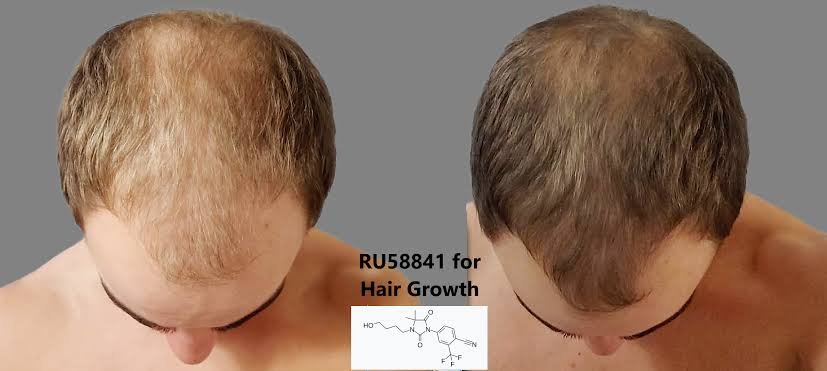
RU58841 for Hair Loss: Benefits, Research, Safety and Comparison With Finasteride
Hair loss can be frustrating, especially when it gradually affects hair density, confidence, and appearance. Male pattern baldness, also known as androgenetic alopecia, is one of the most common forms of hair loss. It is closely associated with genetics and the effects of androgens on sensitive hair follicles.
Among the experimental compounds attracting attention in hair-loss research is RU58841. It is a non-steroidal anti-androgen that researchers have investigated for its potential to interfere with androgen activity in hair follicles.
Interest in RU58841 Australia has also grown among people researching alternative approaches to hair loss. However, questions remain about its effectiveness, safety, regulatory status, and how it compares with established treatments such as finasteride.
This article explores how RU58841 works, what scientific research currently tells us, and the important differences between RU58841 and finasteride.
What Is RU58841?
RU58841 is an experimental non-steroidal anti-androgen developed for research into androgen-dependent conditions, including male pattern hair loss.
Unlike conventional treatments that reduce the production of dihydrotestosterone (DHT), RU58841 is designed to interact with androgen receptors. These receptors are involved in the biological processes that influence hair follicles.
In androgenetic alopecia, genetically sensitive hair follicles respond to androgen activity. Over time, this can cause follicles to become smaller, produce thinner hair, and eventually stop producing visible hair.
RU58841 has attracted research interest because its proposed mechanism targets androgen receptor activity rather than directly reducing DHT production.
However, it is important to understand that RU58841 remains experimental. Its potential benefits should not be confused with proven clinical effectiveness.
How Does RU58841 Work for Hair Loss?
To understand the proposed role of RU58841, it helps to understand how androgen-related hair loss develops.
DHT is an androgen produced when the enzyme 5-alpha-reductase converts testosterone into dihydrotestosterone. In people with a genetic sensitivity to DHT, this hormone can contribute to progressive hair follicle miniaturisation.
RU58841 is designed to act as an androgen receptor antagonist.
This means its proposed mechanism involves competing with androgens for access to androgen receptors. By interfering with androgen signalling, researchers have investigated whether it could reduce the effects of these hormones on susceptible hair follicles.
The main research concept involves:
- Interacting with androgen receptors.
- Interfering with androgen-related signalling.
- Investigating the potential protection of susceptible hair follicles.
- Exploring whether local androgen receptor activity can influence hair follicle miniaturisation.
Although preclinical research has provided a scientific basis for investigating this compound, its effectiveness and long-term safety in humans have not been established.
What Does Scientific Research Say About RU58841?
Research into RU58841 has produced some interesting findings, but the available evidence has important limitations.
Preclinical Research
Early studies investigated the compound’s effects on androgen-sensitive hair follicles.
A 1997 study published in the Journal of Investigative Dermatology examined human balding scalp grafts maintained on testosterone-conditioned mice.
Researchers reported improvements in hair growth activity in the RU58841-treated grafts compared with controls. However, this was an animal model involving transplanted human scalp tissue, not a clinical trial in people.
The findings provided a reason to investigate RU58841 further, but they do not establish that the compound works for human hair loss. <Cite refs={[“turn889887search2”]}/>
Registered Human Studies
Two clinical studies involving PSK-3841, another name for RU58841, were registered:
- A four-week study investigated safety and tolerability.
- A six-month study investigated hair regrowth using different topical concentrations.
The six-month study included a planned sample of 120 men with androgenetic alopecia.
Although the studies were registered as completed, publicly available results have not established the compound’s effectiveness or long-term safety. <Cite refs={[“turn889887search4″,”turn889887search0”]}/>
New Human Exposure Findings in 2026
A particularly important development appeared in 2026.
A study published in Biomedical Chromatography investigated the metabolism and elimination of RU58841 in humans. Six healthy male volunteers received a single topical application of a product containing the compound.
Researchers detected RU58841 and a metabolite in blood samples, while additional metabolites were identified in urine.
This finding is important because it demonstrates that topical application does not necessarily prevent systemic exposure.
However, the study was not designed to establish hair-growth effectiveness or long-term safety. Its small sample size and single-application design also limit what can be concluded. <Cite refs={[“turn550279search0”]}/>
RU58841 Australia: Availability, Regulation and Safety
Interest in RU58841 Australia reflects the growing number of people researching experimental approaches to male pattern baldness.
However, availability through online sellers should not be confused with medical approval.
RU58841 is an experimental compound rather than an established, TGA-approved hair-loss medicine. It has not demonstrated the level of safety, effectiveness, and product quality expected of an approved treatment.
Australia’s Therapeutic Goods Administration (TGA) maintains the Australian Register of Therapeutic Goods (ARTG). Medicines generally need to be included in the ARTG before they can be marketed as approved therapeutic products, although specific pathways exist for accessing certain unapproved medicines.
The TGA also explains that products outside the ARTG have not undergone its standard assessment of safety, quality, and effectiveness. <Cite refs={[“turn550279search10”]}/>
People researching RU58841 should consider several important concerns:
- Product quality: Products sold online may have uncertain purity, concentration, and manufacturing standards.
- Systemic absorption: Human research has detected the compound in blood following topical application.
- Long-term safety: There is insufficient evidence to establish the consequences of repeated or prolonged exposure.
- Skin reactions: The safety of different formulations and their effects on the scalp are not adequately established.
- Regulatory uncertainty: Importation and supply requirements depend on Australian therapeutic goods laws and the circumstances of access.
A product labelled as being for research purposes should not automatically be considered suitable or lawful for human use.
Anyone considering an experimental hair-loss compound should speak with a qualified Australian healthcare professional rather than relying on online product claims.
RU58841 vs Finasteride: What Is the Difference?
The comparison between RU58841 vs finasteride is particularly interesting because both compounds relate to androgen activity, but they work through different mechanisms.
Finasteride is an established medication used to treat male pattern hair loss. RU58841, on the other hand, remains an experimental anti-androgen without established clinical effectiveness.
Understanding these differences helps explain why the two compounds should not be considered interchangeable.
How Finasteride Works
Finasteride works by inhibiting the type II 5-alpha-reductase enzyme.
This enzyme converts testosterone into DHT, which plays an important role in androgenetic alopecia.
By reducing DHT production, finasteride helps limit the hormonal activity responsible for progressive hair follicle miniaturisation in genetically susceptible individuals.
Unlike RU58841, finasteride has undergone extensive human clinical testing.
Clinical research has demonstrated improvements in hair counts among men receiving finasteride compared with placebo. <Cite refs={[“turn550279search1″,”turn550279search17”]}/>
How RU58841 Works
RU58841 follows a different research approach.
Rather than targeting the enzyme responsible for DHT production, it acts as an androgen receptor antagonist.
Its proposed mechanism involves interfering with androgen signalling at the receptor level.
This distinction has made RU58841 an interesting subject in hair-loss research. However, its proposed mechanism does not establish that it provides better results or fewer side effects than finasteride.
RU58841 vs Finasteride Comparison Table
| Comparison | RU58841 | Finasteride |
|---|---|---|
| Main mechanism | Androgen receptor antagonist | 5-alpha-reductase inhibitor |
| DHT production | Not designed to reduce DHT production | Reduces DHT production |
| Research status | Experimental | Established medication |
| Human evidence | Limited and incomplete | Extensive clinical evidence |
| Long-term safety | Not established | Better characterised |
| Medical approval | Not an established approved hair-loss treatment | Approved for male pattern hair loss in relevant jurisdictions |
| Main research interest | Blocking androgen receptor activity | Reducing DHT levels |
Which Has Stronger Scientific Evidence?
Finasteride currently has considerably stronger clinical evidence.
It has been studied in controlled human trials, and its benefits and potential adverse effects are better understood.
RU58841 has an interesting mechanism and some promising preclinical findings. However, the absence of publicly available clinical outcome data makes it difficult to determine whether it provides meaningful hair-growth benefits in people.
There is also no reliable direct clinical trial demonstrating that RU58841 is more effective or safer than finasteride.
Therefore, finasteride has a much stronger evidence base for treating male pattern hair loss. <Cite refs={[“turn550279search1″,”turn550279search17″,”turn889887search5”]}/>
Potential Benefits Being Investigated
RU58841 has attracted attention because of its proposed ability to interfere with androgen activity around susceptible hair follicles.
Some of the potential benefits researchers have investigated include:
Targeting androgen receptors: Its mechanism provides a different research approach from treatments that reduce DHT production.
Local treatment approach: Topical formulations have been investigated to understand whether androgen receptor activity can be affected through scalp application.
Hair follicle protection: Preclinical research has explored whether blocking androgen signalling could help preserve hair follicle activity.
Alternative research pathway: Its mechanism offers researchers another way to investigate androgenetic alopecia.
It is important to remember that these are research interests rather than established clinical benefits. There is not enough evidence to recommend RU58841 as a proven hair-loss treatment.
Potential Risks and Side Effects of RU58841
One of the biggest concerns surrounding RU58841 is the lack of reliable long-term human safety information.
Although topical administration is intended to deliver a compound to a particular area, it does not guarantee that the substance stays within the scalp.
The 2026 human exposure study detected RU58841 in blood following topical application, highlighting the importance of investigating systemic exposure. <Cite refs={[“turn550279search0”]}/>
Potential safety concerns include:
- Local scalp irritation or sensitivity.
- Uncertain effects associated with systemic absorption.
- Unknown consequences of prolonged exposure.
- Uncertain effects on hormonal signalling outside the scalp.
- Differences in product purity and formulation.
These concerns should not be interpreted as a confirmed list of RU58841 side effects. Reliable clinical data are not sufficient to establish its complete adverse-effect profile.
Anyone experiencing unexpected symptoms after exposure should seek medical advice.
RU58841 vs Finasteride: Which Is Better for Hair Loss?
The answer depends on whether the comparison is based on scientific evidence or experimental mechanisms.
Finasteride is the more established option because its effectiveness has been evaluated through human clinical trials. It also has known limitations and potential side effects that patients can discuss with their doctors.
RU58841 offers a different approach to androgen-related hair loss, but its clinical benefits remain uncertain.
People should not assume that topical application makes RU58841 safer than oral finasteride. More research is needed to understand its absorption, effectiveness, and long-term effects.
What Are the Established Alternatives for Hair Loss?
People experiencing hair thinning have several established treatment options worth discussing with a healthcare professional.
Minoxidil
Minoxidil is a well-known hair-loss treatment available in topical formulations. It works differently from finasteride and is used to support hair growth and improve hair density in suitable patients.
Finasteride
Finasteride is commonly prescribed for male pattern baldness. It reduces DHT production and can help slow progressive hair loss.
However, it is not suitable for everyone and can cause adverse effects, including sexual side effects. Medical advice is important before starting treatment.
Hair Transplant Surgery
Hair transplantation is another option for people experiencing established hair loss.
The procedure involves relocating hair follicles from donor areas to areas affected by thinning. Suitability depends on factors such as donor hair availability, hair-loss progression, and individual expectations.
A dermatologist or qualified hair restoration specialist can help identify the most appropriate approach.
Frequently Asked Questions About RU58841
What Is RU58841 Used For?
RU58841 is an experimental non-steroidal anti-androgen investigated for androgen-dependent conditions, including male pattern hair loss. Its proposed mechanism involves blocking androgen receptor activity.
Does RU58841 Actually Regrow Hair?
Preclinical studies have reported positive findings involving hair growth and androgen-sensitive follicles. However, publicly available human clinical results have not established that RU58841 effectively regrows hair in people.
Is RU58841 Available in Australia?
RU58841 is discussed and marketed through online research-chemical channels, but online availability does not mean it is an approved medicine. It is not an established TGA-approved treatment for hair loss. Australian importation and supply requirements should be checked with the TGA.
Is RU58841 Better Than Finasteride?
There is insufficient clinical evidence to establish that RU58841 is better than finasteride. Finasteride has undergone extensive human testing, while RU58841 remains experimental.
Does RU58841 Lower DHT?
RU58841 is designed to block androgen receptor activity rather than directly inhibit DHT production. Finasteride works differently by reducing the conversion of testosterone into DHT.
Is Topical RU58841 Completely Safe?
No. Topical application does not guarantee that a compound stays within the treated area. A 2026 human study detected RU58841 in blood after topical exposure. Its long-term safety remains uncertain.
Can RU58841 Be Used With Finasteride?
There is insufficient clinical evidence to establish the safety and effectiveness of combining RU58841 with finasteride. Anyone considering multiple hair-loss treatments should consult a qualified healthcare professional.
How Long Does RU58841 Take to Work?
There is no scientifically established treatment timeline for RU58841 because its effectiveness in humans has not been adequately demonstrated. Claims about specific regrowth timelines should be treated cautiously.
Final Thoughts
RU58841 is an interesting compound in the field of androgen-related hair-loss research. Its proposed ability to interfere with androgen receptor activity offers a different scientific approach from established treatments such as finasteride.
However, promising research mechanisms do not automatically translate into proven results. Although preclinical studies have produced interesting findings, important questions remain about human effectiveness, systemic absorption, and long-term safety.
For people researching RU58841 Australia or comparing RU58841 vs finasteride, the most important consideration is the quality of scientific evidence. Finasteride remains the better-established treatment, while RU58841 requires substantially more clinical research before its potential role in hair-loss management can be determined.
Leave a Reply